

The Reckoning: Where the Hunter's Energy Transition Currently Stands
By Andrea Hoymann | Hunter iF Board Director
This is part 2 of a four-part series on the Hunter Region's economic and cultural transition. The series explores the heritage that shaped the region, the transformation currently underway, the innovators driving it, and the question of what kind of place the Hunter wants to become.
There is a temptation, when writing about the energy transition, to tell a clean story. Coal exits, renewables enter, workers retrain, the future arrives on schedule. It is a tidy narrative. It is also not what is happening in the Hunter.
What is actually happening is more interesting, and more honest.
Two things are true at once
Drive through the Upper Hunter today and you will pass infrastructure that would have been unimaginable a decade ago. At the former Liddell coal power station site near Muswellbrook, closed in April 2023 after more than 50 years of operation, a 500 megawatt battery is now being commissioned. One of the largest grid-scale batteries in Australia, built on the same land that once burned coal to keep the state's lights on.
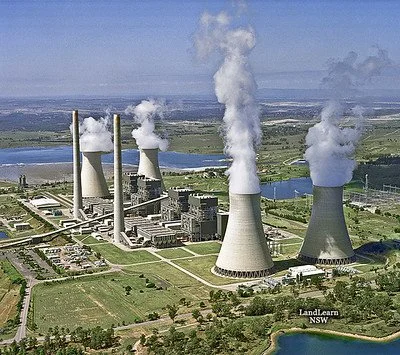
Aerial view of Bayswater Power Station
Fifteen kilometres away, Bayswater coal power station is still running.
This is the Hunter's transition in miniature: not a replacement, but a coexistence. New energy infrastructure is being built, often on the footprint of the old. The Hunter-Central Coast Renewable Energy Zone received final planning approval in September 2025 and construction started earlier this year. A federally declared offshore wind zone covers 1,854 square kilometres off Port Stephens. On Kooragang Island, the Port of Newcastle is developing a Clean Energy Precinct on land that currently loads coal ships.
All of these are large scale commitments to an energy transition.
And yet. Eraring Power Station on Lake Macquarie has had its closure date extended twice. It is now scheduled to run until April 2029. The reason for the extensions is that the renewable rollout is taking longer than projected, and the grid needs the capacity in the interim. It is an acknowledgment of how hard it is to rewire an energy system while keeping the lights on.
The jobs question is not resolved
The coal industry directly employs around 14,750 people in the Hunter. When you include the broader supply chain, contractors, services, transport, that number is closer to 37,000. These are not abstract figures. They are households, mortgages, school fees, local businesses that depend on the spending of mining families.
The Hunter Jobs Alliance, a coalition of unions and community groups formed in 2020, has been making the case for a dedicated transition authority with a specific budget, a long time horizon, and a mandate to work directly with affected communities. The Latrobe Valley Authority (now part of Regional Development Victoria), established when Hazelwood power station closed in 2017, is the model they point to. By 2019, 74 percent of former Hazelwood employees had found new employment or retired.
The Hunter does not yet have an equivalent institution. What it has is the architecture of one: retraining programs, government funds, university partnerships.
The University of Newcastle's New Energy Skills Hub, announced in March 2026 with $20 million in joint federal and university funding, is one concrete piece. Whether that architecture becomes a coordinated system, or remains a collection of well-intentioned programs, is still being determined.
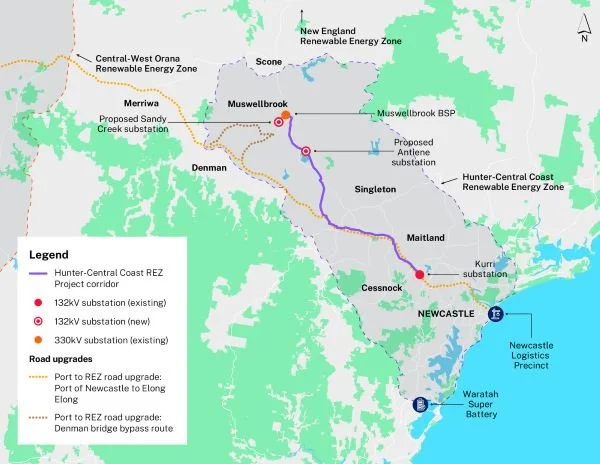
Hunter-Central Coast Renewable Energy Zone
The hydrogen story has been revised
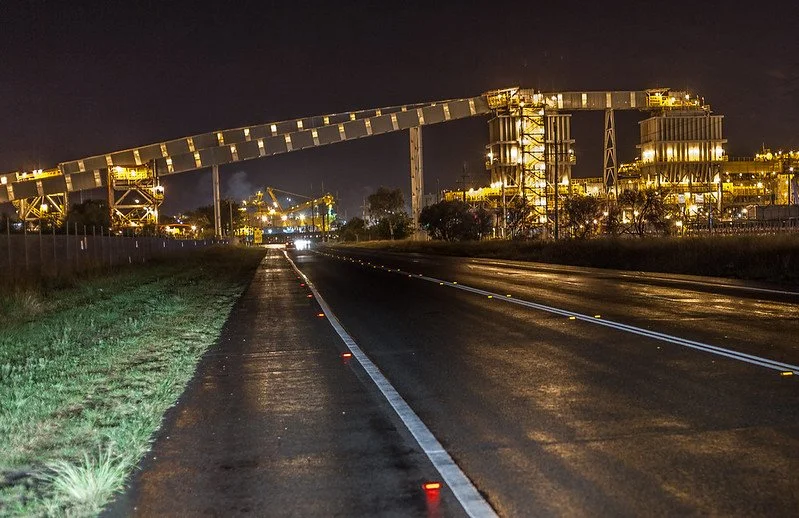
Coal Loader at Kooragang Island
In the wake of COP26, there was real optimism about the Hunter becoming a global hub for green hydrogen export. That version of the story has been substantially revised.
Several projects that looked promising in 2021 and 2022 did not proceed. The economics of green hydrogen proved harder than anticipated, particularly for export at scale. The market is developing, but more slowly and in a different shape than early projections suggested.
What has emerged instead is a more grounded industrial story. Orica, the explosives manufacturer with a long presence on Kooragang Island, secured $432 million in federal government funding in July 2025 to produce renewable hydrogen and low-carbon ammonia, not for export, but to decarbonise its own industrial processes. That is a less dramatic headline than "hydrogen export capital." It may also be a more durable one. Decarbonising existing heavy industry, using the workforce and infrastructure already in place, is the kind of transition the Hunter's geography makes possible.
Decades, not minutes
I watched the Ruhr Valley's transition play out over decades. It did not become a cultural destination overnight. The process involved real hardship, unemployment, and unglamorous years of rebuilding before anything resembling a new identity took hold. Pittsburgh lost around 150,000 manufacturing jobs between 1979 and 1987. The city that replaced them, built around healthcare, universities, and technology research, took the better part of three decades to take shape. Both stories still left parts of each region behind.
The Hunter is not mid-transition. It is at the beginning of one that will take decades, involve genuine difficulty for some communities, and produce opportunity for others. The outcome will depend less on any single project or policy than on whether the region can hold the complexity without forcing a premature resolution.
The Hunter has the assets for a credible transition. What it is still building is the story that holds them together.
Next in this series: The Builders: Who is driving the Hunter's new economy
Andrea is a Board Member of Hunter iF and the founder of Signal & Orbit, a fractional CMO and go-to-market consultancy based in Lake Macquarie. She has spent 15 years working across journalism, media and B2B marketing strategy in Germany and Australia.