

Why this year's Hunter Innovation Festival is putting real health innovation centre stage, and the researchers, clinicians and founders leading it.
The Hunter punches well above its weight in health research. Hunter Medical Research Institute has been bringing together the University of Newcastle, Hunter New England Local Health District and our community since 1998. Our researchers win national grants year after year, working on everything from childhood cancer to heart health to infant breathing.
But too much of that work stops at the paper. It's published, cited and admired, then it never reaches a patient.
This year at the Hunter Innovation Festival we wanted to tackle that gap directly. So instead of a single health session, we've built a health thread through the whole day on Tuesday 24 November at NEX Newcastle.
Why we're leaning into health this year
Health already shapes the Hunter. Hospitals, clinics and care services are among the region's biggest employers and a huge part of our economy. But delivering health services and creating health innovation are not the same thing.
This year, with the support of our partners, we're shining a light on the second: the researchers, clinicians and founders inventing new devices, diagnostics and models of care right here, and taking them to the world.
That work is having a resurgence in the Hunter. HMRI is helping researchers turn discoveries into products and services. The Health Innovation Living Lab at John Hunter Hospital lets clinicians test ideas where care actually happens. I2N's Healthtech Accelerator is backing a new wave of local health founders. The festival is our chance to put all of it in one room.
It starts with someone who has done it
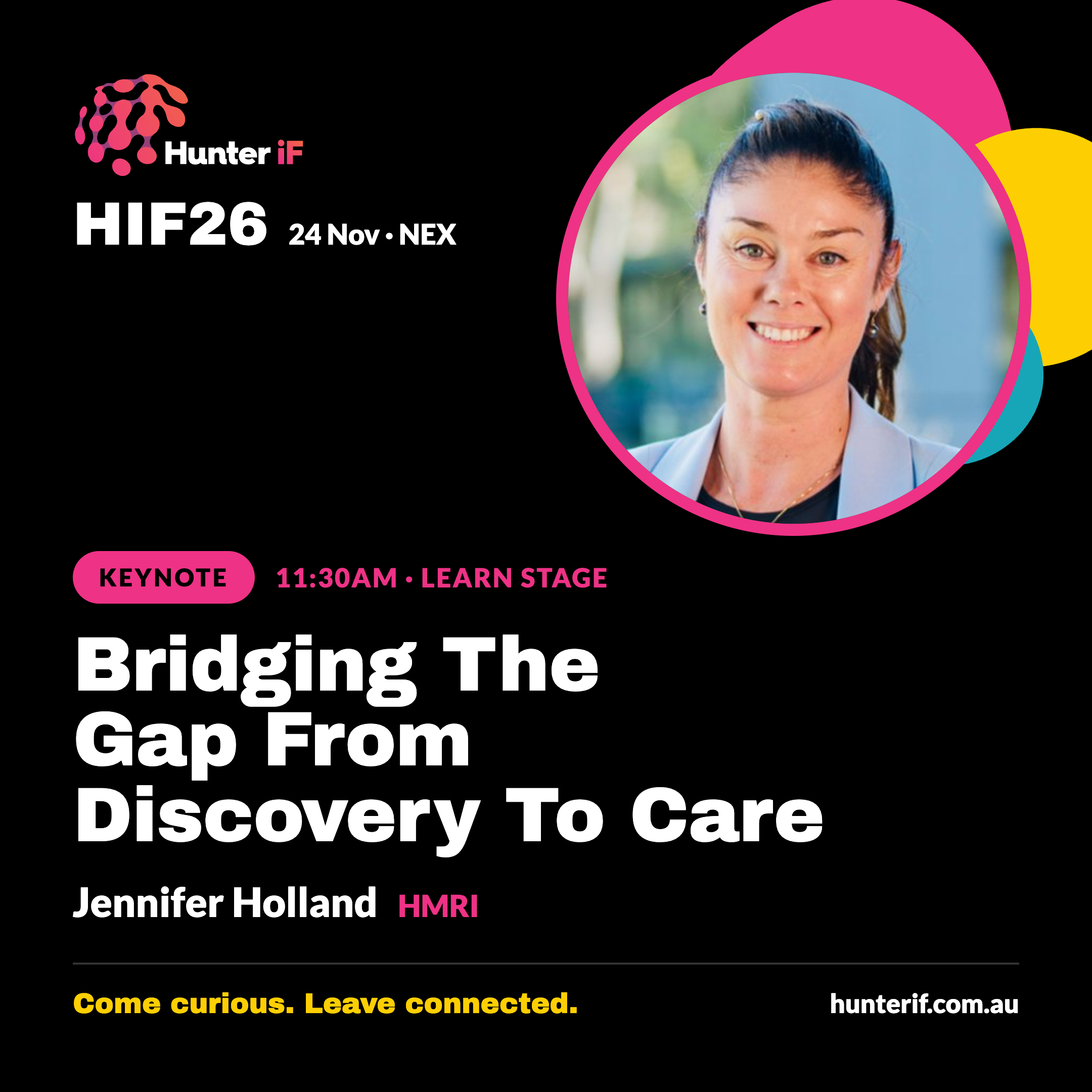
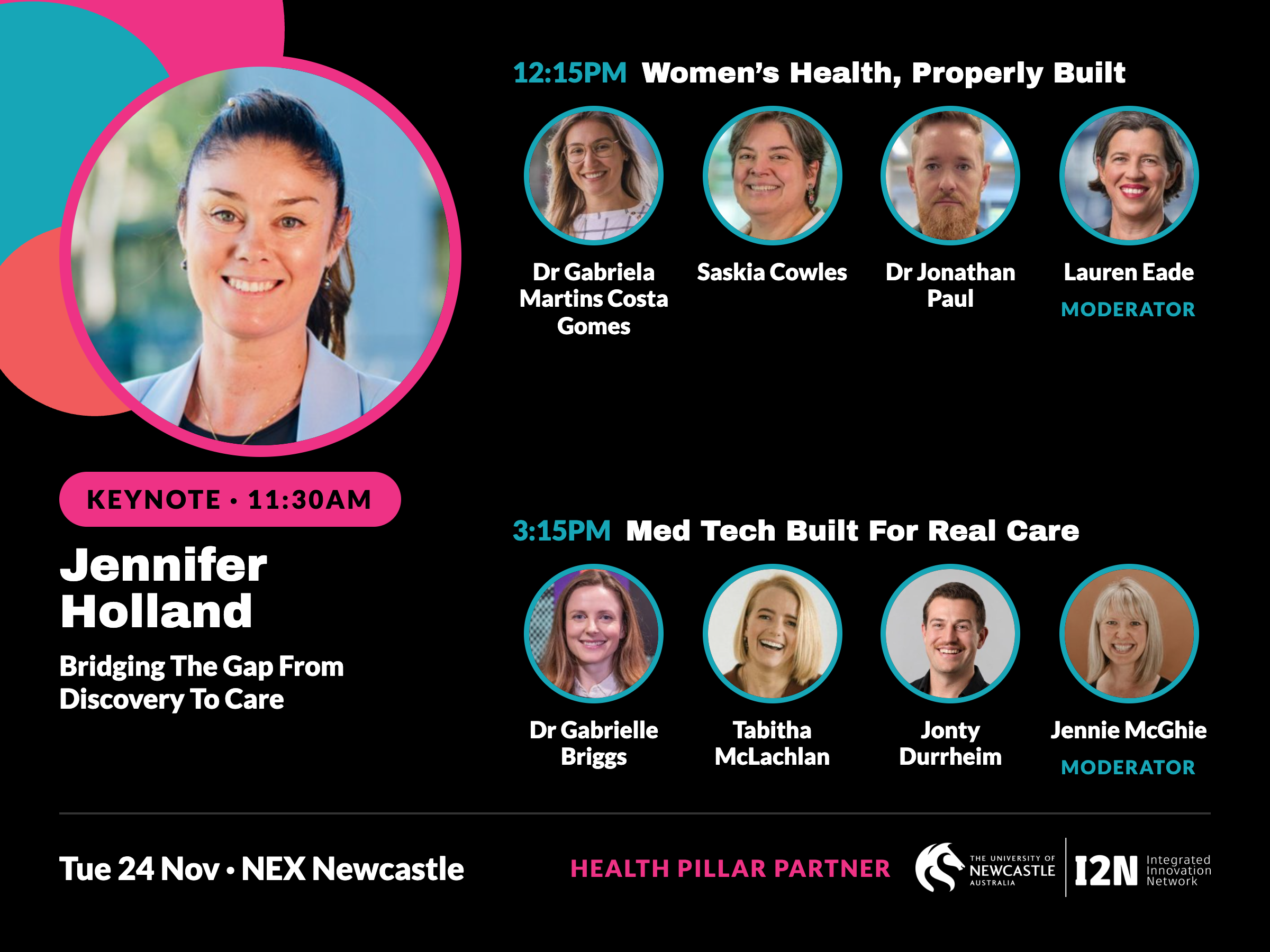
At 11:30am on the Learn stage, Jennifer Holland gives our health keynote, Bridging The Gap From Discovery To Care.
Jennifer has spent 15 years building and commercialising medical devices. She invented Throat Scope, took it through Shark Tank and into global markets, and she now leads research translation at HMRI. Not many people can explain both what a researcher needs and what a market will pay for, and she's one of them. Expect a clear-eyed look at what actually works when you turn regional health research into products, systems and care.
Then, women's health
At 12:15pm on the Connect stage, Lauren Eade from Davies Collison Cave moderates Women's Health, Properly Built.
Women's health has been under-researched and under-served for a long time, which also makes it one of the biggest opportunities for impact we have. Lauren is joined by three University of Newcastle researchers. Dr Gabriela Martins Costa Gomes is developing early detection diagnostics for infant breathing. Saskia Cowles is a psychologist and lecturer. Dr Jonathan Paul is Co-Director of the Mothers and Babies Research Program. They'll talk about finding the unmet needs, designing with patients rather than just for them, and getting through regulation and adoption to something that scales.
And finally, med tech in the real world
At 3:15pm, Jennie McGhie moderates Med Tech Built For Real Care with Dr Gabrielle Briggs (University of Newcastle and HMRI), Tabitha McLachlan (University of Newcastle) and Jonty Durrheim (Valkin Biosystems).
A device that works in a lab is the easy part. It also has to get through regulation, manufacturing and procurement, be adopted by clinicians, be trusted by patients, and fit into a working day on a ward. This panel goes through that whole journey, honestly.
There's more health across the day too. Jakobi Stegh from Mechanistic Health opens the 10am lightning talks, and Andrew Sturt from CareMaster joins our Services Are The New Software panel at 11:30.
Why the University of Newcastle matters here
I want to say a proper thank you to the University of Newcastle, our Health Pillar Partner.
Look at almost any part of health innovation in the Hunter and you'll find the University in it. It's a founding partner in HMRI. With Hunter New England Local Health District and HMRI, it runs the Health Innovation Living Lab at John Hunter Hospital, where clinicians, researchers, students and startups develop and test ideas in a real hospital. Through I2N, its Healthtech Accelerator backs founders across the Hunter and Central Coast, whether or not they have any link to the University.
You can see it on our program, too. University of Newcastle researchers are on every one of our health sessions. That's not a sponsorship line. It's what the region's health innovation actually looks like.
A massive thank you to the people at the University who made this happen: Dr Belinda Gray, Business Development Manager (Health Sciences) in Knowledge Exchange and Entrepreneurship (KEE); Siobhan Curran, Acting Director of KEE; Richard Berry, Manager of Startup Programs at I2N; and Elizabeth Stares, who leads the University's Health Innovation Living Lab (HILL) program.
Why this one is personal
I'm so proud to put these innovators in the spotlight. Women's health matters to me through every stage of life, and more than I can easily put into words.
At 40 weeks' gestation, we lost our son, Oscar. Within 16 months I was holding our gorgeous baby girl, Ella. Then came the roundabout of growing our family: 15 miscarriages and then two rounds of IVF to find out why. We never nailed the why.
Those years were hard: huge moments of joy, tinged with the bittersweet reality of loss. Showing up for my family, my friends and my profession was a test of physical endurance, and a lesson that life is the best gift we can give and receive.
I had the best care, the best doctors and the best support. What about the families who don't? How can we innovate to help them?
That question is why this part of the program matters so much to me. Women and their families need the right services to help them through the worst moments, and the right systems in place when they go through some of the riskiest procedures of their lives. The best possible outcomes shouldn't depend on luck. They're built, by people like the ones on our stage.
That's why I'm so glad to have researchers working on everything from mothers and babies to infant breathing sharing their work at the festival. I hope you'll come and hear them.
Who should come
If you're a clinician with an idea you can't shake, a researcher wondering what happens after the grant, a founder trying to get a product into a hospital, or an investor looking at health, this is your day. Come for the keynote, stay for both panels, and use the breaks for the conversations that make the most of them.
The festival runs from 8:15am to 6pm at NEX Newcastle on Tuesday 24 November. You can see the full program and get your ticket at https://www.hunterif.com.au/2026-festival.
I'll see you there ❤️
Zara Crichton is CEO of Hunter iF and Festival Director of the Hunter Innovation Festival.
