

The Ship Isn't Coming. So We're Building Our Own!
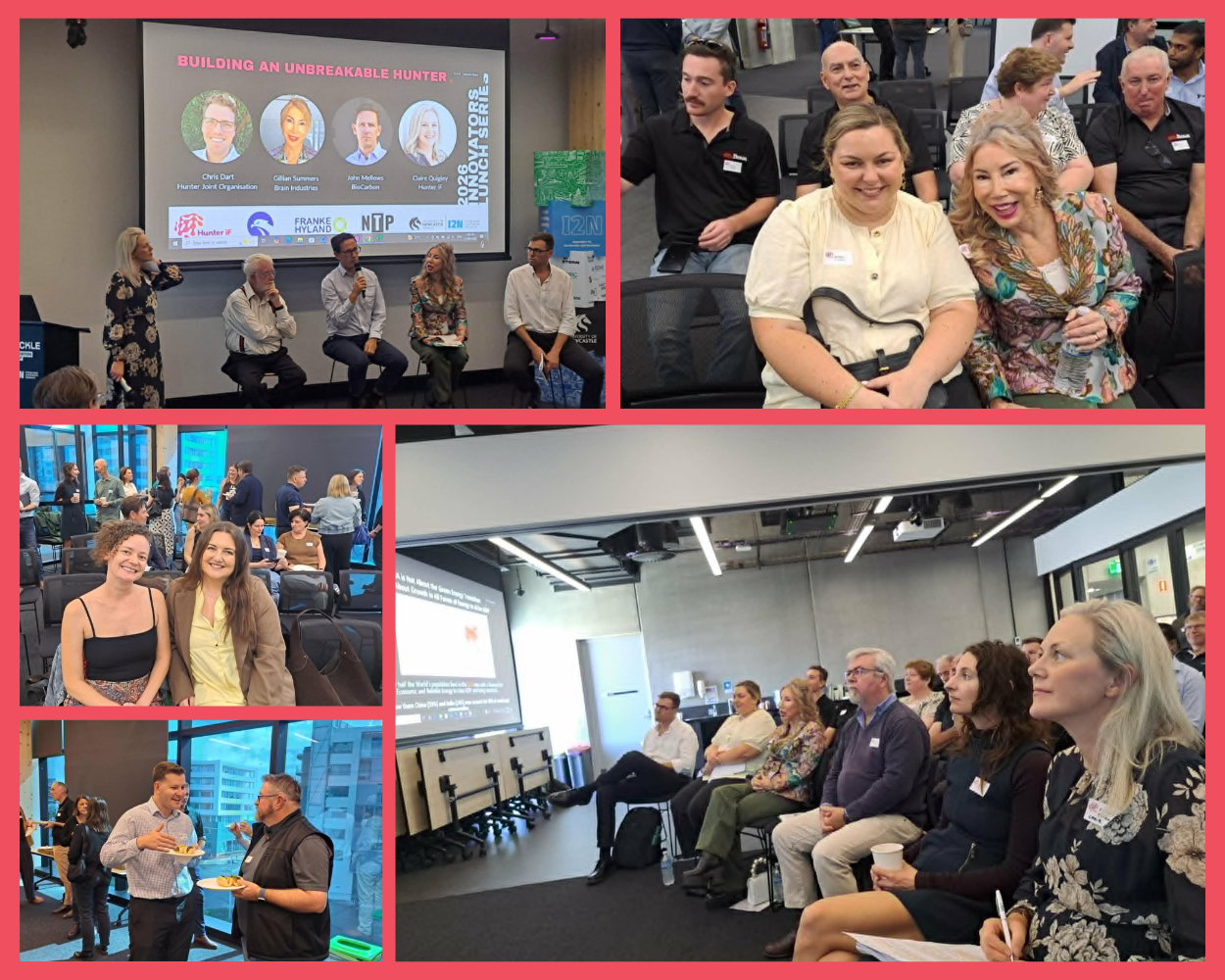
A full house at I2N Hub Honeysuckle for April's Innovators Lunch — The Ship Isn't Coming: Building an Unbreakable Hunter.
April's Innovators Lunch carried a blunt title: The Ship Isn't Coming. The reality, as the panel laid it out, is both more complicated and more urgent. Ships are still coming to Newcastle, for coal, because Asia's energy demand is expanding faster than any transition can absorb. What's no longer reliable is everything else: the global supply chains that deliver the materials, components, and inputs the Hunter's industry depends on. Geopolitical instability, freight volatility, and rising nationalism are rewriting the rules. The question is whether we're building local alternatives fast enough.
Don't Chase What Can Leave Before Lunch
Gillian Summers, Co-Managing Director of Brain Industries, provided the historical anchor. She was here in 1998 when BHP announced the closure of steelmaking in Newcastle. 2,500 jobs gone, national headlines declaring the city finished. What followed was a choice, and the Hunter chose reinvention.
The clearest lesson from that period, looking back: don't chase what is mobile and transitory. Call centres arrived after BHP left. They didn't include steelworkers, and they could leave again. The more durable path was building from what was genuinely here.
That lesson applies directly today. Australia ships out coal, gas, iron ore, and critical minerals, then imports finished products back at a premium. In a world of rising nationalism and fracturing supply chains, that model is not a risk to manage. It is a vulnerability to fix.
Summers' answer to what the Hunter can become is neither modest nor vague: one of Australia's leading advanced manufacturing export regions, scaling industries that are already here: batteries and electrification, defence, clean energy. Boeing anchoring aerospace at Williamtown. Hanwha building missiles here for the first time outside Korea. The foundation exists. What's needed is the confidence and coordination to scale it.
What It Actually Takes: The Biochar Case Study
John Mellowes of BioCarbon brought the most instructive example of the day. BioCarbon's Two Rivers project converts waste char into a net-zero coke substitute for steelmaking, replacing an imported carbon additive with a locally produced one. Sound concept. Clear environmental case. Compelling commercial logic.
It still took years.
Price-matching imported coke required developing a new process from scratch. Getting a steelmaker to trial an unfamiliar input took three months just to produce enough product for a single test run. Securing capital took two more years after that, with ARENA's $4.8 million investment the critical breakthrough. And then came the regulatory maze with current EPA waste-to-energy legislation that limits where this process can legally occur to four designated sites in the state.
It's a reminder that regulation can cut both ways: the FOGO mandate, which requires businesses to separate food and organic waste, gave composting companies across the region the market certainty to invest in infrastructure. The same logic, applied poorly, adds years to timelines innovators can ill afford.
For BioCarbon, the wait may be nearly over. As southern coalfield mines approach the end of their economic life over the next decade, biochar's moment in the steelmaking supply chain is coming. Patient capital, it turns out, has a timeline.
Pick a Direction
Chris Dart, Regional Waste Coordinator at Hunter Joint Organisation of Councils, made the most strategically pointed observation of the afternoon: the Hunter needs to commit to a direction.
Specialising in a handful of industries, naming them publicly, and aligning government planning and procurement behind them is how regions create the certainty that attracts private capital. Without that signal, investors and innovators navigate a system that is perpetually uncertain about its own priorities.
The region already has genuine assets. A deep-water industrial port that Sydney can no longer match, an international-standard airport punching well below its weight, degraded mining land ripe for adaptive industrial reuse, and what is arguably the largest advanced manufacturing cluster outside a capital city in Australia. The circular economy infrastructure to connect these assets is being built, imperfectly and incrementally, through shared council investment in aggregation and sorting capacity.
The pieces are here. They just need a frame.
The April Innovators Lunch didn't end with a roadmap. It ended with a sharper question: will the Hunter use the window to build something that doesn't depend on what arrives by sea?
Based on the conversation in that room, the answer is beginning to look like yes.
The Hunter iF Innovators Lunch series brings together innovators, industry leaders and change-makers from across the Hunter Valley each month. Become a member or follow us on LinkedIn to join the conversation.