

Capturing the Future at the Hunter New Energy Symposium
By Zara Crichton, CEO, Hunter iF
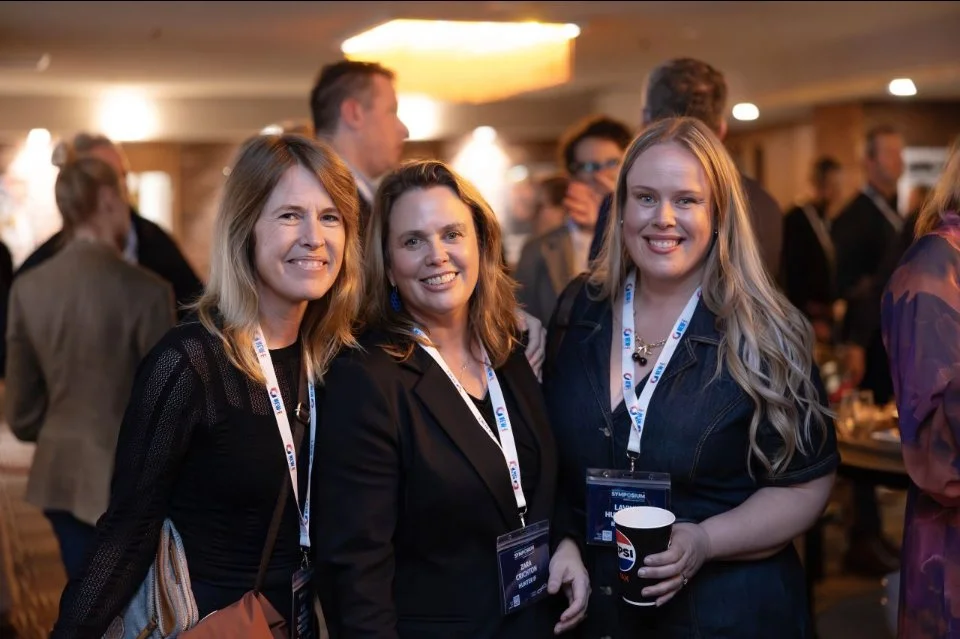
Alice Thompson, Zara Crichton & Lavinia Hutchinson
Held in late May 2026, the Hunter New Energy Symposium brought together industry leaders, researchers, and policymakers to discuss a defining question for our region: In an increasingly contested global landscape, how does the Hunter out-deliver the rest of the world?
The global race for clean energy investment is accelerating. Regions worldwide are facing similar challenges, fiercely competing for the same vital resources: investment capital, new industry footprints, and top-tier talent. As the energy transition moves rapidly from the planning phase to on-the-ground execution, the Hunter finds itself at a critical juncture.
But as I walked the floors of the symposium alongside Hunter iF Board Chair Claire Quigley and Board Member Bret Barton, it became abundantly clear that the real magic of this event wasn't just happening on the stage; it was happening in the hallways. The side conversations over morning coffee, the rapid-fire brainstorming during lunch, and the candid debates over dinner are where the actual deals are struck. That is where our ecosystem's true power lies. We don't just talk about innovation; we build the relationships required to execute it.
The Ingredients for Success
In a compelling address, Clare Larkin-Sykes outlined our region's current standing. The Hunter already possesses many of the fundamental ingredients required to lead the new energy economy:
Deep Industrial Capability: A legacy of heavy industry, manufacturing, and construction expertise.
Export Infrastructure: Established global trade pathways and port capabilities.
Collaborative Research: World-class research institutions driving innovation.
Human Capital: A highly skilled and adaptable workforce.
However, having the right ingredients does not guarantee success. The defining question for us at Hunter iF, and for the region as a whole, is whether we will successfully capture the wave of global investment to build a thriving, localised new energy economy, or whether we simply become a "delivery location" facilitating the prosperity of other regions.
Global Reality & Following the Money: The Tim Buckley Keynote
Providing a blunt, high-octane reality check on the global clean tech race, Climate Energy Finance Director Tim Buckley positioned Australia's transition within a fast-moving, hyper-competitive global landscape. As a former investment banker, Buckley’s perspective was anchored strictly in finance, market data, and geopolitical realities, a perspective we critically need.
The Anatomy of Disruption
Addressing recent pessimism surrounding offshore wind and green hydrogen (which some have labelled a "train wreck" after a massive correction in market hype), Buckley reminded us that industrial disruption is never smooth. He drew a direct parallel to the dot-com crash: the initial internet bubble burst spectacularly, yet a decade later, it fundamentally changed global commerce. The clean energy transition is following the same trajectory.
The Scale of China's Clean Tech Dominance
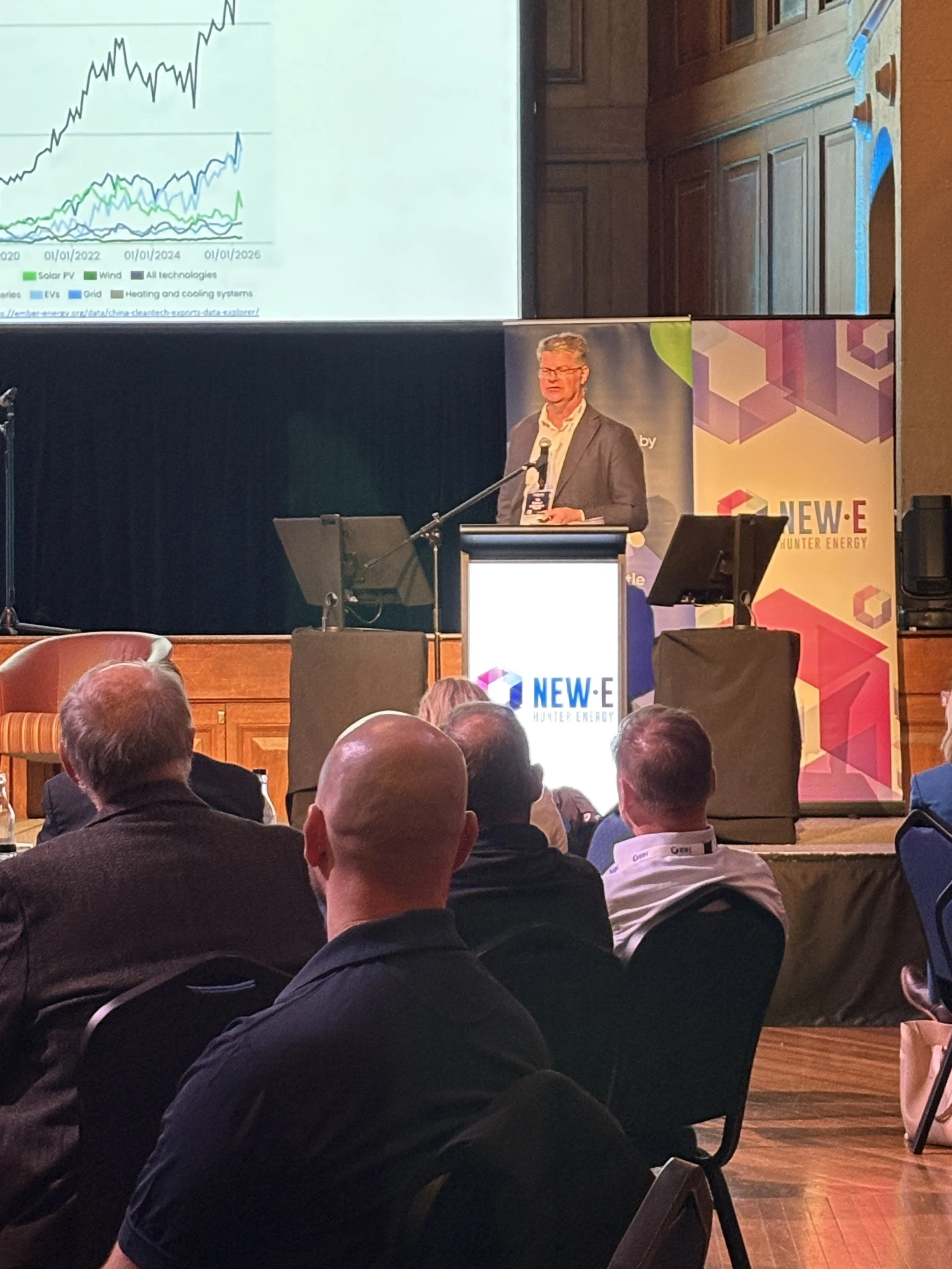
Buckley urged local leaders to look past the political landscape of the United States and focus on where the capital is actually flowing. Globally, $2.3 trillion was invested in clean technology last year alone.
Rather than viewing China’s market dominance with hostility, Buckley framed it as an unprecedented opportunity for a trade-exposed nation like Australia, noting that China currently controls 50% to 90% of global market share across solar, EVs, and batteries, handles 80% of global battery recycling, and installed 75 gigawatts of renewable capacity in just the first four months of 2026.
"We are a highly trade-exposed country", Buckley warned. "If we don’t respond and partner with them to adopt this technology, we will get run over by an electric truck that is moving very fast towards us."
The Policy and Reliability Tightrope: Tony Wood's Pragmatic Outlook
Energy expert Tony Wood offered a sobering look at domestic policy, grid reliability, and the distinction between political promises and economic reality.
Wood pointed out that Australia's historical emissions have essentially flatlined over the last five years. Bending that curve down to hit the legislated 43% reduction by 2030 is a monumental task. While recent drops in the default market offer for electricity are welcome, Wood warned against political over-promising. As ageing coal-fired power stations eventually close, wholesale markets will re-equilibrate, and prices are likely to flatten or rise slightly.
However, there is excellent news for the consumer: Energy bills will go down, even if unit electricity prices fluctuate. The true savings lie in the electrification of homes and transport. To navigate grid reliability challenges, Wood stressed that Australia must move away from an "every child gets a prize" approach to subsidies, and instead clearly identify and aggressively support industries (like Tomago Aluminium and major steelworks) that have a commercially viable future in a low-emissions world.
Summing up the complex landscape of the transition, Wood offered a quote that perfectly captured the mood of the room: "If you're not pessimistic about where we're at, you don't understand the numbers. If you're not optimistic about where we're going, you don't know the capacity of people to get things done."
The Epicentre of Change: Muswellbrook's "Industrial Repositioning"
Bringing these macro-level policies down to the absolute coalface, Muswellbrook Shire Mayor Jeff Drayton discussed the impending realities for his community.
Mining is woven into our DNA, contributing roughly 60% of New South Wales’ $70 billion mining economy. But the impending cliff is approaching rapidly. By 2030, two massive coal mines in the region, including BHP’s Mt Arthur and a neighbouring Glencore site, will close, resulting in an estimated 12,000 job losses. To put that into perspective, that is four times the size of the historic BHP Steelworks closure in Newcastle.
Rather than a "transition", Drayton framed the Shire's strategy as an "industrial repositioning". To capitalise on the retiring mines' deep grid connections and rail networks, Muswellbrook is acting with urgency:
The Project Pipeline: The council is currently in active talks regarding 20 different renewable energy projects, some valued upwards of $10 billion.
Rewriting the Rules: Through a $5 million federal grant, the Shire is piloting a groundbreaking project at BHP’s Mt Arthur to rezone the untouched buffer land on the lease while the mine is still operating, allowing advanced manufacturing and pumped hydro infrastructure to be built in parallel.
The Multiplier Effect: Moving Beyond the "Network"
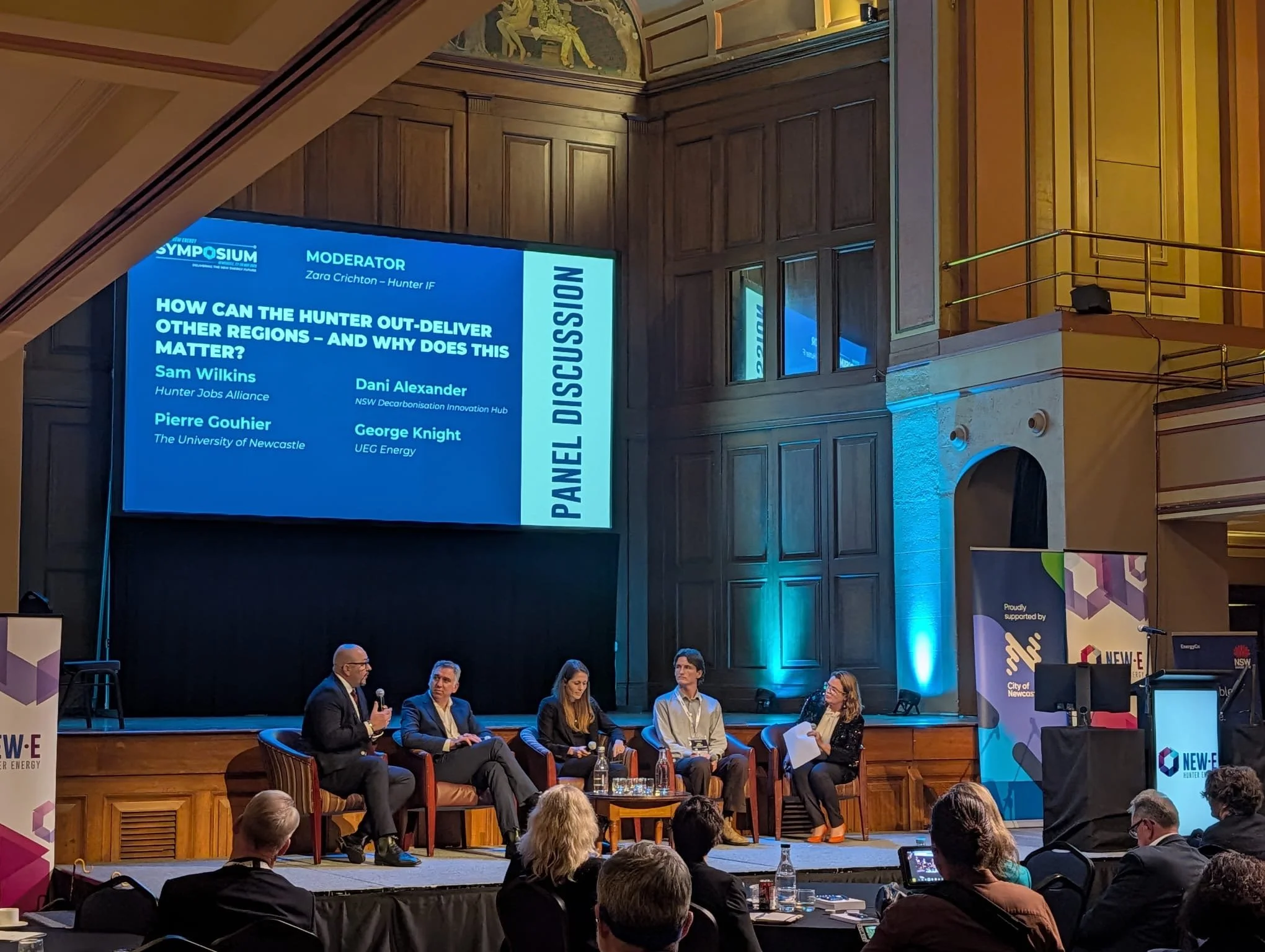
When I stepped onto the stage to moderate our Hunter iF panel, Delivering Competitive Advantage, I wanted to push the audience out of their comfort zones. We needed to move past the comfortable "network effect" (the idea that we succeed simply because the Hunter is a "20-minute town" where everyone knows each other) and pivot towards the "multiplier effect", a state of dogged, active collaboration where our interconnectedness directly de-risks multi-million-dollar projects for global investors.
We didn't shy away from the friction points:
Translating Research:Pierre Gouhier (NIER/TRaCE) addressed the tension between academic timelines and industrial urgency. Because the Hunter already possesses heavy industrial assets, researchers can bypass the standard delays of greenfield sites, piloting and scaling new technologies at an accelerated pace.
The Policy Pipeline:Dani Alexander (NSW Decarbonisation Innovation Hub) detailed how competitive the landscape has become. State funding will flow towards areas that prove they can move ideas out of the lab and into execution swiftly. The Hunter’s "gritty, collaborative ecosystem" is our primary differentiator.
The Commercial Reality:George Knight (UEG Energy) brought a developer's raw commercial reality to the stage, arguing that local supply chains are not a luxury, but a commercial survival mechanism. Bypassing global supply chain bottlenecks requires immediate access to local service providers to save both time and capital.
Grounding the Workforce:Sam Wilkens (Hunter Jobs Alliance) grounded us in the human element. Even with billions of dollars in capital, the transition fails without human capital. Upskilling workers from legacy sectors into clean tech roles requires local sourcing and community-led labour programs.
Hallway Hustle: Where the Real Work Gets Done
While the keynotes and panels provided the framework, the heartbeat of the symposium was in the interstitial moments. This is where Claire, Bret, and I valued our time.
The economic realities presented by Ahwin Clarke, including the massive influx of data centre investments and rising national electricity demand, were heavily debated over catered lunches. When EnergyCo presented their updates on the Newcastle Logistics Precinct and the Hunter Transmission Project, you could immediately see local suppliers in the foyer exchanging business cards and forging the very local supply chains George Knight championed on my panel.
At the dinners we saw academic researchers breaking bread with private equity financiers, bridging the exact friction gaps we discussed on stage. That is the multiplier effect in action.
From Ambition to Execution: The Reality of Project Delivery
In a subsequent panel hosted by Bob Hawes of Business Hunter, industry leaders discussed the practicalities of delivering mega-projects like Orica’s Hunter Valley Hydrogen Hub and the Port of Newcastle’s Clean Energy Precinct.
Despite these exciting projects, David Cooper from Allens highlighted that the broader investment landscape is facing turbulence due to a lack of certainty. Projects currently face immense red tape simply to connect to the grid.
Crucially, the panel agreed that delivering these projects requires robust social licence. Heather Stevens from the City of Newcastle highlighted that councils are on the front lines of community engagement, but a stark reality raised during the audience Q&A is that the community often feels excluded from the decision-making process. We need an overarching, trusted process for engagement that counteracts misinformation and ensures the community is genuinely heard.
Building Resilient Prosperity
Closing the day, Dr. Paul Ebert (NIER) reflected on the profound relationship our region shares with First Nations peoples and our educational institutions, a foundational relationship critical to building equitable, long-term prosperity.
Leaving the symposium, my takeaway is crystal clear. The Hunter has the industrial muscle, the infrastructural footprint, and a staggering pipeline of investment waiting to be unlocked. But to avoid being left behind in the global race, we must move with unprecedented unity, agility, and vision. We must take the dogged collaboration we fostered in the hallways and dinners this week and apply it to every single project we build tomorrow.
